Sunday, 17 February 2013

Sunday brunch

Sunday is my only free day so I usually like to sleep late and make an effort when preparing breakfast (which is usually eaten at a more lunch-like hour). This week I discovered a great new recipe blog, and the pancake recipe is from there. Today's brunch consisted of pancakes with chocolate sauce, organic berries and maple syrup. It was all a little sweet for my usual taste, but hey it's Sunday.
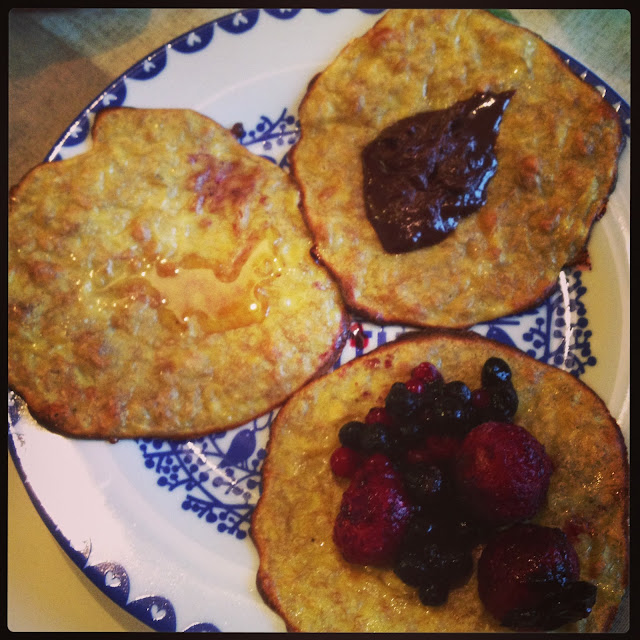


Banana & peanut butter pancakes (for 1)

1 very ripe banana
1 egg
a tiny amount of baking soda
1 tbsp peanut butter
a little salt

1. Put the oven on 200°C.
2. Mash the banana until smooth. Add the remaining ingredients and mix.
3. Pour the dough into 4 pancakes on a baking tray with baking paper.
4. Bake for 15-20 min or until golden brown.


Chocolate sauce

2 tbsp butter or coconut oil
2 tsp honey
2 tbsp raw cacao powder
1/2 tsp bourbon vanilla

Mix all the ingredients in a bowl and that's it. Although if the butter is very hard you might want to put the bowl in some hot water for a while to soften it.

Emma

Tuesday, 12 February 2013

Morning Bowl

How I start my mornings nowadays:
1 grated apple
shredded coconut
chia seeds
wheat grass powder
sultanas
cinnamon
almond milk
hazelnuts


Obviously you can mix this up endlessly, but this variation has been a favorite for a while now.

-anna

Friday, 25 January 2013

Quick avocado and garlic lunch


I've been sick for over a week now, but today I decided I want to eat something proper and of course easy since I'm really low on energy. I came up with a healthy mix from stuff I had at home, and it turned out delicious even if I couldn't quite taste everything.. I think this might become a lunch classic for me!

What you need (for 1 person):


Noodles or pasta, I used buckwheat noodles but you can use whichever kind
olive oil
half a small onion
2 garlic cloves, crushed
1 avocado
alfalfa sprouts
the juice from half a lemon
1 tbsp pumpkin seeds
some other healthy oil, I used camelina
salt


1. While the noodles are boiling, cut the onion and fry quickly in olive oil.
2. cut the avocado.
3. When the noodles are done, remove the water. Put them in a bowl and add the fried onion, crushed garlic, alfalfa, salt, oil, and avocado. Mix and then sprinkle with pumpkin seeds and lemon juice.

I think this can also be eaten cold, so it's fine to prepare it in the evening and take it with you to work the next day for example.


Emma


Wednesday, 11 April 2012

The Truth

I will only leave you guys with a link today, as this is an awesome article that almost says it all. Read it and learn.

Quantum Biology

Taken from Kris Carr's website, crazysexylife

<3 anna

Monday, 9 April 2012

Easter food 3: Pasha

Caution: hideous amounts of dairy involved so skip this post if you avoid dairy!

This is actually my favourite easter food (apart from the obvious chocolate, but since that's eaten outside of the easter times it doesn't count). I've never made it before and have always thought it's really difficult to make since you need all sorts of things that sounded too inconvenient. Well yesterday I proved myself wrong because it actually turned out to be really easy, just as most things I try seem to be :) And it is by far the best-tasting pasha I've ever had. So here is my recipe for this Russian easter dessert:


Pasha for 8

500 g organic quark
4 dl organic whipping cream
200 g organic butter
1-2 dl palm sugar/honey/agave syrup
2 egg yolks
the juice of 1 lemon
the grated peel of 1 orange
1 dl crushed organic almonds
1dl mixed dried organic fruits
3 tsp organic natural vanilla
a pinch of quality salt
some raisins or other fruits for decoration

a thin tea towel or a cloth meant for cooking
a strainer


1. Let the butter soften in room temperature for a while. Then mix the soft butter and sugar in a bowl until fluffy. Whip the cream in a separate bowl. Add the content of one bowl to the other and throw in the rest of the ingredients too. Mix until homogenous.

2. Line a strainer with thin cloth, put the strainer in a bowl so that a little space is left at the bottom of the bowl. Pour the pasha mixture in the clothed strainer and cover with a plate turned up-side-down. Put in the fridge to strain over night.

3. The next day, take hold of the strainer and the plate (leaving the bowl) and turn the whole thing around so that the plate is now the right way up and the pasha is neatly on top. Remove the strainer and the cloth and your pasha is done! If you want you can decorate it with some imaginative designs :)


Happy easter!

Emma

Friday, 6 April 2012

Easter food 1: Karjalanpiirakka

Karjalanpiirakkas (Karelian pastries) are Finnish pastry kind of things that we like to eat. They're traditionally made with buckwheat flour although nowadays people tend to use rye or even wheat. They are eaten with a kind of egg butter on top, which really tops them off. The pastries are really easy to make although it takes a while, and I think they're delicious. A friend of mine just asked me for the recipe because she thought she might make them for easter. I don't think they're a typical easter food, but I do think they suit the occasion, considering especially that they involve eggs. So here's what you need if you want to try them out:


For the filling (rice porridge):

1 litre milk (raw & organic, or nut or seed milk if you avoid dairy)
2 dl water
2 dl organic porridge rice or risotto rice
1,5 tsp quality salt

For the dough:

ca 4 dl organic buckwheat flour (you can also use rye)
2 dl water
1,5 tsp quality salt
1 tbsp quality oil


plus some butter to put on top


before going into the oven


1. Make the rice porridge by putting the water to boil and then adding the rice. Let it simmer until the rice has soaked up the water. Then, begin adding the milk, little by little, while the rice soaks it. This will take almost an hour. Add the salt. Let the porridge cool down when it's done.

2. Make the dough by mixing all the ingredients together. Form into a ball and put in the fridge for a while.

3. Divide the dough into as many parts as you want (depending on which size pastries you want to make) and start rolling each piece into thin circular shapes with a rolling pin. For this you will need more flour to keep the dough from sticking to the table or the rolling pin.

4. Start adding scoops of cold porridge on the flat pastries and "wrinkle" the sides of the pastry up with your fingers. Put a knob of butter on each.

5. The oven should be on 250 °C. Put the pastries on a baking sheet and bake for ca 15 minutes, or until the rice filling is a little coloured.


as a side dish at dinner


And for the egg butter to use as a spread on top:

Boil ca 4 eggs. Brake them with a fork in a bowl, adding butter (ca 100g), salt and a lot of chopped fresh parsley or chives.


Hope you like them! More easterish recipes will follow soon (as soon as I prepare something), and next time they will be sweet.


<3 Emma

Sunday, 18 March 2012

Yoga by Rachel

This is an interview with Rachel, one of my teachers during my 4 weeks here at Samahita. She's a really good teacher and she has helped me to understand many things about yoga.


How and when did you get into yoga?

I first started when I was a child, I used to do the headstand for long periods of time, although I didn't know it was yoga at the time. My mother didn't really stop me. Then I didn't do yoga again until I was at a friend's party in France where a friend was teaching partner yoga. So we were helping each other into these postures, and it was just lovely. And after that I started to go to classes in London. This was around 1999. I decided to become a teacher in 2005 after I did my teacher's training. Before that becoming a yoga teacher was a dream I had, maybe from the first time I went to a yoga class. But I knew I had a long way to go.


Do you think everyone should practice yoga?

Yoga has many forms so the physical postures is just one aspect. I think everyone can benefit from those, but also from the other limbs of yoga. The asana is more physical, but there are also less physical aspects, such as meditation. And also the state of yoga is something that I think people experience whether or not they practice the postures. So yes, I think everyone should get to experience the state of yoga.


Do you teach different people in different ways?

Yes. I love teaching people individually because I think we are very different, physically, mentally, emotionally and energetically. I enjoy finding the approach that works for each person.


What does yoga mean to you?

I think it means a state of being connected to your higher self. And experiencing every moment with awareness. And it doesn't necessary have to mean practicing postures, although it does help.


What is the most important thing to remember when practicing yoga?

You can only ever be where you are. And if you let that happen, self-acceptance comes and true progression arises.


Do you have some tips for someone who is just beginning?

Find a good teacher! To begin with, a good place to start is at the beginning, take a beginner's course.


How important do you consider the mantras?

They are only important if they are said with intention and meaning. I think that if you don't really connect with them or have a real aversion to them, they're not completely necessary. I think you can still have the intention in your heart without saying the mantras, but they do help. And they're said to be more powerful when you say them in your mind. That's what I tend to do when I'm practicing asana.


Can there be yoga without pranayama (breathwork)?

Yes. Other styles of yoga, such as Iyengar don't focus on the pranayama. But Ashtanga does. They both lead you to the same place, just using a different approach. Ashtanga should definitely be done with the breath, otherwise it can be a little bit harmful and cause strain on the body and mind.


Give 3 examples of how yoga can help us.

It can help you become more self-aware. And more flexible and strong and healthy. And it helps you become more calm and to let go of stress.


Thank you Rachel!


<3

Emma

Friday, 16 March 2012

My yoga

Since my one month yoga holiday is soon reaching its end I want to talk a little about yoga. I could write about the philosophy behind yoga, or about the rules and guidelines, but you can probably find all that on some really good webpage if you're interested. Plus, it wouldn't really be yoga from my point of view, from my own experience. So I decided to write about what it all means to me, what is my yoga?


I'm quite new to yoga, and it's only during the past few weeks that I've begun doing my own practice, instead of a lead class. Mysore is the word used in Ashtanga for self-practice. This means that a teacher is present, but they only assist you where required, and give you new asanas (postures) when they see you are ready to go deeper into your practice. Before I started doing the mysore I went to lead classes, during the first 2 weeks here. This gave me a really good base, kind of a stand on which I could learn to balance. I learned the basic asanas and began to remember the sequence by heart. But it was not until I started the mysore that I learned what yoga could be, for me. During my first own practice I already realised that yoga will teach me more about my body than I could have known. It felt like I was only getting to know my body, from the start. I was so happy when I realised this, it felt like I suddenly started a new friendship, with my own body. Then on the second day I realised how stiff I was. I could feel blocks in my body, remnants of emotional traumas and behavioural patterns. I was disappointed at how strong these barriers inside me seemed to be, and I knew I had a long way to go to unlock them. But I also noticed how I had already begun the process of opening them. I felt emotions rise to the surface only from doing that physical practice. A huge relief came over me, it felt like I was releasing emotional strains that I didn't know I had. And simultaneously I feel that my whole body is gradually changing. I feel taller and stronger, and just more in touch with my body. I also feel a sort of calmness, especially right after each practice. That particular feeling could be enough of a reason to continue doing yoga when I go back home.


I know that this process is only in the very beginning, the experience is only starting. Realising this, I see a glimpse of what yoga can give me. It's incredible how they knew thousands of years ago exactly how I should use my body. I have no doubt that everyone can benefit from yoga.


I'll soon post an interview that I did with one of my teachers here, to give you an idea of what yoga is for someone who is much more experienced than me.

Shanti,

Emma

Monday, 5 March 2012

Ignorance Is Not Bliss

I went into work for a free breakfast today, and while eating, I was browsing through today's paper. I came across some statistics about what Australian school kids know (or don't know as it turns out) about where food comes from etc. I will post a picture of it below. Anyways, this is all insanely appalling to me. Seriously, how can you think yoghurt comes from a plant? It's so sad because there's no way you could ever expect these kids to make smart choices about food since they don't even know what it is. It just goes to show that, again, the root of the problem is lack of knowledge. It is so important that kids are taught where their food comes from, and what it actually is they are eating. I'm getting so annoyed and sad by this so I won't write any more about it. But people, talk about food, show interest in it, find out what it is you are putting in your body, choose that which is best for you and our planet, treat yourselves with love and pass that mentality on to your children!
I will be back with something nicer next time.

apologies for the poor quality of the picture.

<3 Anna

Wednesday, 22 February 2012

Yoga


I'll tell you more about my yoga holiday soon, but before that you can enjoy this video (without thinking I'm anywhere near that kind of a level).

<3

Emma

Tuesday, 21 February 2012

Bananas About Pancakes

Something I have been almost overdosing on here in Australia is bananas. They are cheap, super good, and tend to keep you full longer than any other fruit. Bananas are an excellent source of vitamin B6 and also contain some vitamin C, manganese and potassium. I think not a day has gone by so far that I haven't had at least one banana. When you eat them this much, you really want to change things up every once in a while. Now, as it happens, I was in Indonesia last year for a month, and had banana pancakes for breakfast quite a lot during that time. Nowadays, when I don't really want to have anything to do with wheat, and try to avoid a lot of other cereals as well, I haven't had any banana pancakes in a long time. That is, until I discovered how to make a cereal-free version. Oh happy day! 
So what you need for about 2 pancakes is as follows:
1 banana
4 eggs (two with yolk, and two without)
cinnamon
salt
olive oil

Simply mash the banana, add the eggs, cinnamon and salt, blend, and fry them all up, using the olive oil (or any other vegetable oil you might prefer)
Remember to use 100% organic cruelty free eggs!


A simple yet delicious breakfast for lazy mornings!

-Anna

Thursday, 16 February 2012

Sunshine preparations

I told you before that I would talk more about sun exposure, so here it goes! On Monday I am off to Thailand and for about 3 weeks I've been preparing myself for a month in the sun without sun screen. The thing is, we don't really need sun screen, and we're actually much better off without it. Here's why. Firstly, sun screens block the sun's UVB rays, which are essential for our bodies' production of vitamin D. So even if we spend 12 hours a day in the sun, we still don't get any vitamin D if we use sun screen as a block. Secondly, sun lotions are packed with nasty ingredients, and it has even been shown that they increase the risk of skin cancer, which is the complete opposite to what they're claiming to do. Many of these lotions contain substances which, when exposed to the sun, become highly carcinogenic and thus cancer-producing. Plus of course all the other toxic ingredients found in any non-organic skincare.

Read this article for more information:
http://www.naturalnews.com/032996_sunscreen_cancer_risk.html


To prevent our skin from burning in the sun, there are various natural methods we can use. Many natural fats make excellent sun lotions. Today I made my own sun lotion, which is nothing less than superfood for the skin. Here's what I put in it:


Organic Jojoba oil

Organic virgin coconut oil

Organic cacao butter

Organic shea butter (with honey & black seed oil for a lovely smell)


I'm not sure about the amounts, but this is the order (highest amount first):

1. Coconut oil
2. Cacao butter
3. Shea butter
4. Jojoba oil


In addition to a good sun lotion, which is applied externally, there are a few ways to internally prepare our bodies for the sun. The best way is by eating antioxidants because they counteract the activities of free radicals, which are the cause of sun damage. I told you about my juicing in the previous post. Carrots are especially good because they contain the antioxidant betacarotene, which prevents the skin from being burnt by the sun. Celery is also great because it promotes the production of collagen in our bodies, and thus quickens skin renewal. In addition to food, there are some supplements we can take in order to minimise the risk of getting burnt by the sun. Astaxanthine is basically the red colour found in algae and some fish, and taken as a supplement is one of the most effective ways to prevent us form sun damage. Lycopene is another antioxidant which can be taken as a supplement and is also red in colour. It is found in some red vegetables and fruits, such as tomatoes, papaya and watermelon. Lycopene has been proven to have anti-cancer properties and is very powerful in fighting the oxygen produced on the skin during sun exposure (free radicals).


That's it for my part, hope you find these tips useful. Remember that carrots should be eaten for at least 2 moths before sun exposure, and astaxanthine and lycopene should also be taken from a few weeks before going to the tropics, and the use should be continued throughout the trip. Basically, eating all this throughout the year is not a bad idea :)

Oh, I almost forgot to tell you about my trip. I'm going for a 1 month yoga holiday, with yoga practice twice a day, 6 days a week. I can't wait! I'm taking my laptop with me so you'll probably get some news from over there at some point, probably yoga-related news ;)


Lots of love and happiness,

Emma

Friday, 3 February 2012

Aussie Observations

Hello all, I have been absent for a while, my apologies. I am now in Australia, and have been here for a month today actually. I will update every once in a while about what I see and eat here.

What people seem to eat most of here would be junk food, in all forms. Chips, crisps, hamburgers, fried chicken, meat in all possible ways, chocolate, ice cream... The list is never-ending. One thing that I find extremely annoying is that they don't really seem to have understood that you can actually make smoothies without dairy or sugar. I tried asking for one made with soy milk (which is definitely not ideal, but still) and what I got was a yellow sugary mass I had to struggle really hard to finish. I'm really missing my favorite smoothie bar in Finland at the moment. I have to admit, I have definitely not been good about my eating here, but I'm improving every day. The one thing that is huge here is juices, you can get freshly squeezed juices pretty much anywhere, so that's a definite plus. Superfoods are definitely not as visible here as they are in Finland, but there are some awesome places for that too, I will be back with reviews at a later point. Everything is pretty expensive here, I thought Finland was expensive, but this does seem to be a bit worse. What I'm struggling with most is to find something healthy and cheap to have for breakfast. At the moment I start my days with muesli, some fruit and almond milk with a cup or two of green tea. I would like to get rid of the muesli, I will see what I come up with. I'm gonna try a banana pancake recipe soon, will get back with details on how it went!

Below is a pic of my very first meal in Australia, buckwheat blueberry pancakes with berries, mango and organic mashed apples.


love,
anna

Saturday, 28 January 2012

Canned Dreams


Canned Dreams | Trailer from OktoberFi on Vimeo.

When shopping for food people often complain about the high prices. But have you ever wondered how a can of ravioli can cost 1 euro? If you look at the list of ingredients and the metal used for the can, how can all that be worth so little? This film shows the journey of the ravioli can, and it shows you the sacrifices made in order for you to be able to complain that 1 euro is too much. I saw the film today in the cinema where I work, and I realised it is the answer to the questions of all those people I know who wonder about my strange eating habits. Why do I choose organic? Why do I choose local? Why do I skip prepared and canned food? And why don't I eat meat? Watch this and you will know. I cried because of the cruelty of this world that we call civilisation. And I cried because those animals reproduce, because their sole purpose is to exist for us to walk over them. The Polish guy who murders cows for work, he who is describing how he wants to kill the man his wife fell in love with while he himself was sleeping with another woman; if he worked on a small biodynamic farm, planting beautiful flowers, I hardly think he would like to kill anyone. But there is no use blaming the workers, or even the corporate executives and owners. It is us who are to blame. Us, who buy these products which can hardly be called food. We make all this possible. A complete reconfiguration of values is needed. Next time you think real, organic, natural, healthy food is too expensive, think about whether you need those new jeans or that bigger tv. Or whether you would rather put your money into your well-being, health and happiness. Alarm bells should start to ring when a price is as low as that can of ravioli, it simply is not the right value for food.

Emma

Thursday, 26 January 2012

Roasted müsli


Home-made müsli can be 1000 times better than the ones bought in shops. Yesterday I prepared a wintery kind, focusing on nuts instead of fruits and on warming spices. Here's how to make it:


What you need

The amount should add up to ca 1 litre

Buckwheat flakes
Millet flakes
Almonds
Brazil nuts
Cashew nuts
Pumpkin seeds
Sunflower seeds
Sesame seeds
Goji berries
Cold-pressed sesame seed oil (ca 3 tbsp)
Honey (ca 2 tbsp)
Ground cinnamon (3 tsp)
Ground cardamom (2 tsp)
Ground ginger (2 tsp)
Ground cloves (1 tsp)


How to do it

1. Roughly crush the nuts and almonds (not the seeds) in a mortar.
2. Mix all the ingredients in a bowl.
3. Spread the mixture on a baking sheet with baking paper.
4. Roast in a 150°C oven for ca 20 minutes, turning at times. Be careful not to burn the müsli! When the kitchen starts to smell good and the flakes and nuts gain a golden colour, your müsli is ready.
5. When the müsli has cooled, you can put it in an air-tight glass-jar and store in the fridge.


This müsli is delicious on a cold winter's morning due to its warming properties. Eat with raw milk like I did, or mix with natural organic yogurt. Remember to use organic ingredients for the best taste and health benefits :) I want to add that the roasting process weakens the nutrient potency of the ingredients, as does heating any food. If this is a problem, you can try making the müsli in the same way, only without the oven. For me the roasting is ok because I don't eat müsli very often, although I think I might make one batch without heating at some point.

I shall be back another day with some more recipes on delicious müslies!


<3 Emma

Saturday, 31 December 2011

Happy New Year everyone!


As the year is changing I thought it would be appropriate to gather a top 10 of all our posts so far. I began the task and before long I realised that I had ended up with a top 20 before I even had gone through half of our posts.. So I decided to leave it and forget about the whole thing. Instead, I want to urge you to make 2012 a year filled with love. Because I can't think of any better answer to every question you ever had than love. What else is there to want or need? If all your thoughts, words and actions stem from love (and you know in your heart when that love is real) what could possibly go wrong? Living from love is the same as following your heart and that in turn means being happy. And it's what the wise people throughout time keep on saying, even if it is sometimes dressed in the word compassion. So whatever new year's resolutions you are making, let them grow out of love for yourself and for everything and everyone else in the universe, because really it's all one and the same.

<3<3<3

Emma

Friday, 30 December 2011

Clay pampering

Hello there! A week of Christmas has gone by, I hope you all got to enjoy it in the company of loved ones with good food and beautiful words. I've been working almost everyday but nevertheless enjoyed the week (I work in a cinema, mostly selling tickets). I consider my work as a kind of workout or challenge, where I get to practise my social skills and become more confident around people. And it has definitely worked wonders so far. Apart from working I've had many opportunities to conduct "normal" Christmas activities, such as watching films, reading new books, eating really well, and spending quality time with my family. I even had time for a small pampering session which involved a facial mask of natural green clay. Here's the evidence (extremely charming I know):


I want to talk a bit more about this green clay because it's actually quite an amazing substance (perhaps not aesthetically, at least not on my face). The real name for it is Bentonite or Montmorillonite clay, and it is formed from the weathering of volcanic ash. It occurs naturally in many different parts of the world, most notably in the US. Perhaps the most important medicinal property of green clay is its ability to effectively kill bacteria, something that has been shown through various studies and experiments. It contains massive amounts of trace minerals necessary for our health, commonly up to 75 different minerals can be listed.

The most common way of using this clay is probably what I did, to cover your skin with it or take a clay bath, and almost every spa provides such services. This method has been used throughout history to treat various illnesses such as skin infections, acne, ulcers, or arthritis, or to tone the body and reduce fat.

However, external use is not the only way to benefit from the healing properties of clay, and it is also used internally as an extremely effective natural detox method. This is basically due to the negative charge of the particles in the clay which attract other, positively charged particles such as toxins, bacteria, metals and pesticides. These bad particles adhere to the clay particles, which then transport the toxins out of the body.

Here's a list of some health benefits:

  • cleansing of the liver, colon and skin
  • balancing bacteria in the digestive tract
  • improving nutrient assimilation
  • strengthening of the immune system
  • elimination of food allergies
  • healing the body of food poisonings, viral infections and parasites
  • treating arthritis, pain wounds, diarrhoea, stomach ulcers, acne, anaemia, digestive conditions
  • effective in weight loss
  • re-mineralisation of cells and tissues
  • alkalisation of the body
  • protection against radiation

There are different ways of consuming bentonite clay, but normally ca 1 tablespoon is mixed in a glass of water and drunk daily on an empty stomach.

In my opinion, considering all the toxins and radiation we consume and inhale daily and mostly without noticing, clay is a perfect way of daily healing. Without some sort of detox, our bodies are unable to get rid of all the bad stuff at a rate that would compare to the rate with which it is exposed to them. And the best part of clay is that it's really cheap and can be found in most health food/natural/organic shops everywhere.

More information about bentonite:


<3

Emma

Friday, 23 December 2011

Healthier gingerbread

There is also no Christmas here without gingerbread so I had to make up a recipe for those too :)


Fiery Gingerbread

200 g organic butter (you can use coconut oil if you don't eat dairy)
2 dl coconut sugar
1,5 dl agave syrup
2 organic eggs
8 dl wholemeal organic spelt flour (buckwheat flour can also be used)
2 dl organic potato flour
2 tsp baking soda
3 tsp ground cinnamon
3 tsp ground cardamom
3 tsp ground ginger
2 tsp ground cloves
a pinch of salt
freshly ground black pepper


1. Leave the butter out to soften for a while and beat into smaller pieces.

2. Add the coconut sugar to the butter.

3. Bring the agave syrup to boil and slowly pour the hot syrup in with the butter and sugar. Mix until even.

4. Add the eggs and turn until even.

5. Mix all the dry ingredients (except the black pepper) in another bowl.

6. Little by little, add the flour mixture into the dough and keep turning. Use your hands when the dough gets thick.

7. Shape the dough into a ball and wrap with clingfilm. Put into the fridge overnight.

8. The next day, pour a little flour on a table and roll out the dough with a rolling pin (we used a sigg bottle..). Use gingerbread-molds to press the gingerbread into their shapes. Sprinkle with freshly ground black pepper to get a nice little kick. Lift the breads onto a baking sheet with baking-paper and bake in 200°C for ca 5 min, or until they gain some colour.

Voilà!


I probably won't have time to post anything tomorrow, so Merry Christmas everyone!!


Lots and lots of love,

Emma

Friday, 9 December 2011

The clothes we wear

For a long time now I have wanted to write something about clothing. Wearing clothes is so obvious to us that we hardly think about it. Well of course we think about how we look and whether we're warm or cool enough, but how often do we really give a thought to what our clothing actually is made of? Acrylic fiber, for example, is something so complicated that I didn't understand any of the descriptions offered by Wikipedia. Same thing with polyester. No wonder these textiles don't feel good on the skin when they're so unnatural. Especially in the winter, synthetic fibres become static and make your hair stand up straight, and they're not even warm. Natural fibres are much more pleasant on the skin, and much more practical too.


Cotton is probably the most common material used for clothing and other everyday products such as sheets, towels, tampons, nappies etc. And even though this is a natural plant it's not so simple, because the word 'natural' lost its meaning long ago. Cotton fields only take up 3% of the world's farmland, but they are sprayed with 25% of the world's pesticides and herbicides, including some of the most toxic ones. This might be 'allowed' because cotton is not directly consumed as a food, but our skin absorbs stuff just like any other organs do. Imagine that you're probably sleeping in sheets full of toxins, rubbing your skin against them every night. And it's not just our outer skin, imagine the amount of pesticides absorbed from tampons.. In fact, we even eat cotton, through cottonseeds and cottonseed oil which is used in some processed foods and as feed for cows, entering our bodies through non-organic meat and dairy. Pesticides are not the only danger however, but dyes can be extremely toxic too, containing cancer-producing chemicals. Have you ever noticed how new jeans colour off on your skin? That's not such a good thing because the skin is just the gateway to the bloodstream and the rest of your body, including the brain. As if this wasn't enough, the biggest threat to 'natural' cotton is perhaps genetic engineering. Most cotton-production is owned by a Monsanto monopoly that pushes GE cotton as a 'green alternative'. The truth is, these plants have been genetically modified in a way that they either emit their own pesticide, or are resistant to mega-doses of pesticides. The problem with this is that other plants too become resistant to pesticides, resulting in a never-ending need of new ever more toxic pesticides. This is a real threat to organic cotton, as the GMO cotton crops spread with the wind and can settle in organic fields. If Monsanto inspectors then find these GMOs in an organic field they can basically fine the farmer for growing Monsanto-owned crops illegally. The farmer is then faced with the option to either pay Monsanto huge sums of money or to start growing the GMO plants and basically being owned by Monsanto. The 'cotton suicides' happening in India are a result of this. Basically, whenever you buy cotton that is not 100% organic, you can be pretty sure you're supporting Monsanto. And even if the cotton is organic, the dyes probably aren't.. If you care about these things, it might prove quite a challenge to go shopping, but I have as a rule to always wash everything I buy before I start using it, especially if it's not organic. It's good to wash them separately from old clothes the first time, in order not to contaminate the rest of your clothes. And also, an extra rinse programme can be used at the end. And this process should probably be repeated..a few times. And it probably still doesn't remove all the toxins. Plus you're still supporting Monsanto (unless you buy organic).. My answer: buy second-hand.

More cotton information:

http://www.organicconsumers.org/clothes/index.cfm

http://www.naturalnews.com/031266_GM_cotton_agriculture.html

http://www.naturalnews.com/030913_Monsanto_suicides.html

http://www.eurekalert.org/pub_releases/2011-02/wuis-nfi020711.php

http://www.naturalnews.com/029904_organic_cotton.html


In addition to cotton, there are of course other fabrics that are also natural and much easier to find in a non GMO-version. In the summer I love to use linen and hemp because of their coolness. And wool is of course an obvious choice in the winter. And silk is an incredibly pleasant fabric, and it looks very elegant too.

Here's a blog about organic clothing.

If you want to know more about Monsanto:

http://en.wikipedia.org/wiki/Monsanto

http://www.naturalnews.com/033772_Monsanto_Roundup.html

http://bestmeal.info/monsanto/company-history.shtml

http://www.greenpeace.org/international/Global/international/planet-2/report/2008/3/7-deadly-sins.pdf

http://www.youtube.com/watch?v=_ENPyDuR23s

and a documentary film.


I hope you find what's important for you, and start manifesting it in your life.


Lots of love,

Emma

Saturday, 3 December 2011

Yoga

As promised, I am back with a post on yoga. Last weekend I did an astanga yoga course, to help me get started with it in a proper way. It was a really good introduction, and consisted of three days. Day one was just about an hour of theory, we went though practical stuff and got a brief history of astanga yoga. What surprised me most is that even though it is quite an old practice, it was almost forgotten until about 80 years ago, when it hit another upswing in popularity and is now probably the most popular form of yoga. For me, I want to get into yoga because as I'm having tremendous trouble meditating, I think yoga could be another form of it, or a path towards it.


The two other days we did two hours of training per day. Since I am used to running, I found the yoga practice so much more calming, because you do it in such a slow pace, and you still get a super good workout. There is most definitely enough of a challenge in this for me, as I am sure I will never be able to learn all the poses, but I feel like I will gain a lot from trying. What I was left with after the weekend, besides sore thighs and abs, is a burning passion for this form of exercise and determination to commit to training. Today I did my first training at home, and I loved it. This is another wonderful thing about it, once you sort of get the hang of it, you can train at home by yourself whenever you want, all you need is a yoga mat.

I definitely recommend the course offered at Helsingin Astanga joogakoulu for all our Finnish readers.

Love,
Anna